
FOR IMMEDIATE RELEASE
June 10, 2026
Media contacts
Lesa Griffith
808-532-8712
lgriffith@honolulumuseum.org
Matt Serrao
808-532-8785
mserrao@honolulumuseum.org
VITAL CONNECTIONS:
ART & THE BRAIN
VITAL CONNECTIONS:
ART & THE BRAIN
HoMA EXHIBITION EXPLORES CREATIVITY AND HUMAN HEALTH THROUGH CONTEMPORARY ART AND IMMERSIVE ENVIRONMENTS
WHAT: Vital Connections: Art & the Brain
WHEN: Sept. 12, 2026-Jan. 10, 2027
WHERE: Honolulu Museum of Art, 900 S Beretania St., 808-532-8700
HONOLULU, HAWAI‘I—This fall the Honolulu Museum of Art presents Vital Connections: Art & the Brain, a major exhibition exploring the relationship between creativity and human health. On view from September 12, 2026 through January 10, 2027, the exhibition brings together modern and contemporary artworks, immersive environments, and recent neuroscience research to examine how aesthetic experiences can shape emotion, attention, memory, and wellbeing.
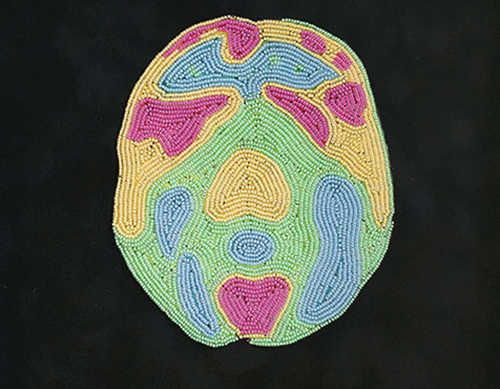
Ruth Cuthand (American, b. 1954). PTSD, 2023. Glass beads, thread, backing. Courtesy the Gallery/art placement inc.
As conversations around mental health, aging, and social connection grow, doctors and health organizations worldwide increasingly recognize the benefits of museum visits, artmaking and music for overall wellbeing. Earlier this year the New York Times called art experiences the “fifth pillar of health” and a recent study showing that engaging with the arts can slow biological aging made headlines in outlets ranging from NPR to CNN.
Developed by HoMA director of curatorial affairs Catherine Whitney in collaboration with clinicians, neuroscientists and neuro-architects from Honolulu’s Brain Health Applied Research Institute (B+HARI), Vital Connections draws on the latest findings in neuroscience to create an immersive environment in which visitors will learn what art is doing to their minds and bodies as they experience it.
Featuring modern and contemporary art by international and Hawai‘i artists—including works by Bernice Akamine, Ruth Asawa, Chuck Close, Ruth Cuthand, David Hockney, Yayoi Kusama and Ming Ren—Vital Connections explores concepts ranging from artistic perception to aesthetic experiences, examining how both can chemically rewire our brains. Audiences will experience the benefits of art by feeling calmed, restored, energized, and immersed in the present, while better understanding the science behind sensory perception, memory, and movement. The exhibition also shares practical methods for building better cognitive resilience through creating and experiencing art.
Curator Catherine Whitney met Dr. Ma Ry Kim while collaborating on the Museum’s 2023 installation Rebecca Louise Law: Awakening, an immersive experience involving thousands of dried flowers. Shortly thereafter, they began discussing the importance of art, design and nature on brain health, something Kim was exploring with fellow B+HARI founder Dr. Kazuma Nakagawa.
“It was such a fascinating and multipronged topic that connected brain health with art practices and culture, that I was immediately sold and wanted to explore, and share, it more deeply,” says curator Catherine Whitney. “Who doesn't want to learn more about our own brain and those of our loved ones through the lens of artists and brain surgeons?”
Collaborating with neuroscientists on an exhibition was a first for Whitney.
She added, “The clinical crew at B+HARI just wants everyone to thrive, learn, and have fun, so I'm adopting that model in this exhibition.”
The exhibition: Going with the
flow
The exhibition begins in an introductory section
with an activity. Visitors will reset their nervous systems with breathing
boxes designed by the B_HARI scientific team, B+HARI architect Dr. Elim Ng and woodworkers from
the community group Honolulu Kūpuna Shed, a creative space for seniors. Feeling
calm and relaxed, guests then make their way through three sections—Perception
and Memory, Connection to the Planet, and Flow: Multisensory Connections—in which modern and contemporary artists explore themes of perception,
memory, awe, and flow state in their works.
Perception and Memory
In this section, visitors will
experience how artists in the past visualized their understanding of the
brain’s mechanics along with works by contemporary artists.
Post-Impressionist, cubist, and contemporary works by Henri-Edmund Cross, David
Hockney and James Seawright visualize modern theories of optics,
psychoanalysis, and time-based perception, while works by Ruth Cuthand and Viviane
Silvera visualize how trauma can affect—and art can help to mitigate—memory conditions
and cognitive losses. Visitors are prompted to step away from a
painting by Post-Impressionist Henri-Edmond Cross to experience visual
perception changes with distance. As the distance between them and the painting
grows, they can see how a pointillist landscape of disconnected dots fuses into
a solid, cohesive image.
Connection to the planet
The second section explores how art
fosters a sense of connection to the self, to each other and to the wider
planet. Experiencing art, whether listening to a symphony, engaging in art
making, or walking into an immersive art installation stimulates mental and
physiological benefits similar to the restorative properties of nature. Art has the
ability to slow down racing thoughts, trigger a sense of awe, and bring us in
touch with vast and mysterious realms beyond our own selves.
Artists in this section, such as John Koga and Jennifer Steinkamp, evoke awe through references to the cycles and patterns of nature using intense color, scale, or digital animation. Richard Misrach’s horizon-less ocean photograph, made at a popular Honolulu beach, taps calm or physical feelings of weightlessness, while a work on loan by Sasha Gordon offers audiences an eerie and fantastical view into nature and consciousness. Gordon’s Tell Me, 2023, reveals a mystical, ecological creature and giant, pearly nautilus, alongside a modern Venus who subverts the traditional male gaze by confronting the viewer. Native Hawaiian artist Bernice Akamine’s ethereal, suspended jellyfish made of glass beads were inspired by the Hawaiian creation chant the Kumulipo and illustrate the link between ancestral connections and the threat of climate change. Nearby, Jennifer Steinkamp’s digital tree, Judy Crook 9, lights up our cerebral cortex with its evolving patterns of seasonal change.
While these works stir physical and emotional intrigue, ranging from ease to discomfort, Ellie Schmidt’s eight-screen video installation, Tidal Pool, turns down the tension barometer. Guests are invited to lounge in beanbag chairs and monitor changes in mood as they experience her tranquil, underwater realm. The exhibition encourages empathy for the natural world, which is threatened by a rapidly warming planet.
Flow: Multisensory Connections
The exhibition’s final section explores how sight, sound
and movement can strengthen our neuronal connections (neuroplasticity) and
cognitive resilience. Flow, in neuroscience, is a highly focused mental state (often
described as “in the zone” or “locked in,”) harnessed by deep engagement in
novel sensory activities or challenging motor pursuits like drawing, crafting, sculpting,
dancing, or even surfing. In this immersive state, focused attention and
creative engagement can heighten awareness and reduce self-consciousness.
In Vital Connections, experiencing works that visualize and trigger flow may help visitors become more attentive and present as they encounter examples of hand-eye coordinated mastery, transcendent sound or movement.
San Francisco-based artist Ming Ren is a painter and creator of interactive installations. His ink work practice involves getting lost in the flow of gestural painting inspired by traditional Chinese landscape painting. He recreates the restorative effects he enjoys through this daily painting practice in his multidimensional, enriched environments. His 2024 video installation, created with his tech-engineer collaborator Hansong Zhang, invites people to “dance with light and color” in front of digital projections inspired by the natural landscape of Hawai‘i. The artists recently updated the multisensory work with new technology that responds to body movements. Visitors to HoMA will be the first to experience this monumental and pioneering collaboration that blends art, technology, landscape, memory and sensory experience.
Other artists included in this section include Ruth Asawa, Georgia O’Keeffe and Emmi Whitehorse.
In a non-traditional approach to art museum curation, Vital Connections reaches across disciplines to combine research-backed solutions from neuroscientific perspectives with guided observation and self-reflection, furthering conversations on the power of art to rewire our brains toward greater cognitive resilience, peak performance aging and enhanced wellbeing.
At a time when many are experiencing stress, isolation, and uncertainty, HoMA presents Vital Connections as a space for the community to engage in discovery and support overall well-being.
Artists in the exhibition:
Bernice
Akamine, Ruth Asawa, Chuck Close, Henri-Edmond Cross, Ruth Cuthand, Sasha
Gordon, David Hockney, John Koga, Yayoi Kusama, Richard Misrach, Georgia O’Keeffe,
Ming Ren, Abigail Romanchak, Ellie Schmidt, James Seawright, Peter Sedgley, Viviane
Silvera, Jennifer Steinkamp, Thomas Struth, Emmi Whitehorse
About the curator
Catherine Whitney is HoMA’s
director of curatorial affairs. As the museum approaches its centennial in
2027, she is overseeing the transformation of HoMA’s permanent collection
galleries and injecting new energy and audience-based approaches into its
ambitious, diverse exhibition program. She previously was chief curator of the
Philbook Museum of Art and held positions at the National Gallery of Art in
Washington, D.C.
Collaborators
Ma Ry Kim is an internationally known neuro-architect and co-founder of B+HARI. Based in Honolulu and London, her work sits at the intersection of neuroscience, architecture and community health. She is also the founder of I-ON Group, where she advances evidence-based design strategies that integrate neuroscience and social equity. She sits on the Inaugural Advisory Council for the Global Brain Care Coalition, established by the McCance Center for Brain Health at Harvard Medical School and Massachusetts General Hospital. She was HoMA’s inaugural scholar-in-residence.
Dr. Kazuma Nakagawa is a prominent neurologist and neurointensivist known for his expertise in stroke and neurocritical care, and co-founder of B+HARI. He leads the Neuroscience Institute at the Queen’s Medical Center in Honolulu and is the division chief of neurology and professor of medicine at the University of Hawai‘i John A. Burns School of Medicine. He has been recognized as a Fellow of the American Academy of Neurology and the American Heart Assocation.
Dr. Courtnee Nunokawa is a scientific faculty member of B+HARI and a leader in the integration of neuroplasticity and clinical practice. She brings profound clinical depth to B+HARI with her extensive experience serving populations that face high neurological burdens and complex social determinants of health, including veterans and incarcerated individuals. She is board-certified in primary care, lifestyle medicine, and neurofeedback rehabilitation.
Dr. Elim Ng is an architect whose work explores how environmental design shapes human experience and well-being. She views architecture as an artistic and ethical practice that supports comfort, safety, and long-term resilience. She holds a Master’s from Tongji University in Shanghai and a Doctorate of Architecture from the University of Hawai‘i at Mānoa.
Exhibition organization and
funding
Vital Connections: Art & the Brain is organized by the Honolulu
Museum of Art. Lead support for the exhibition is provided by Prince Waikiki.
Images available on request.
About the Honolulu Museum of Art
The Honolulu Museum of Art is Hawai‘i’s premier art institution, inspiring and uplifting the community through transformative art experiences. Founded in 1927 to reflect Hawai‘i’s multicultural makeup, today HoMA’s extraordinary collection of more than 55,000 works of art from across the globe spans 5,000 years.
Through its collection, innovative exhibitions, and programs, the museum is able to tell stories relevant to Hawai‘i and the world at large. It serves as a gathering place of learning and discovery, where visitors can encounter new ideas, explore diverse perspectives, develop empathy, and contribute to their well-being through art. Home to an art school, Honolulu’s last art house theater, two cafes, and a shop—just 10 minutes from Waikīkī—HoMA is a vital part of Hawai‘i’s cultural landscape committed to access for all.
Hours: Wednesday, Thursday, Saturday, Sunday 10am–6pm; Friday 10am–9pm
Admission: Adults $25; residents $15; free for youth 18 and under; free for SNAP beneficiaries and college students enrolled at any Hawai‘i state university or college.



Honolulu Museum of Art
900 S Beretania St
Honolulu, HI 96814
Honolulu Museum of Art School
1111 Victoria St
Honolulu, HI 96814
Communications: 808-532-8712
You are receiving this email because of your interest in the Honolulu Museum of Art.