
FOR IMMEDIATE RELEASE
April 23, 2026
Media contacts
Lesa Griffith
808-532-8712
lgriffith@honolulumuseum.org
Matt Serrao
808-532-8785
mserrao@honolulumuseum.org
ARTIST TSHERIN SHERPA'S HIMALAYAN SPIRITS FILL HoMA'S GALLERIES MAY 30
ARTIST TSHERIN SHERPA'S HIMALAYAN SPIRITS FILL HoMA'S GALLERIES MAY 30
Colorful works draw from traditional Himalayan Buddhist art and address timely issues like migration; two new works were created for exhbition
WHAT: Divine Disruption: The Art of Tsherin Sherpa
WHEN: May 30, 2026-Jan. 31, 2027
WHERE: Honolulu Museum of Art, 900 S Beretania St., 808-532-8700
HONOLULU, HAWAI‘I—The Honolulu Museum of Art presents Divine Disruption: The Art of Tsherin Sherpa, a major solo exhibition showcasing the work of acclaimed Nepalese artist Tsherin Sherpa, who recontextualizes traditional Himalayan Buddhist art with a new contemporary relevance.
On view from May 30, 2026, to January 31, 2027, the exhibition traces Sherpa’s remarkable journey from the sacred painting workshops of Nepal to the international art world, through more than 20 works—paintings, sculptures and a carpet—some of which are well-known artworks that established Sherpa as a significant voice in the world of contemporary art, as well as two new pieces created for Divine Disruption.
Sherpa will be at the Museum for the opening and will give a public talk on May 30 at 2 p.m.
The exhibition is co-organized by HoMA and the Seattle Art Museum, which have two of the leading collections of Asian art in the US.
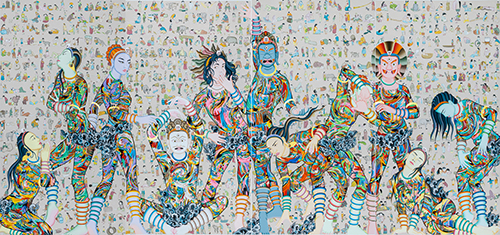
Tsherin Sherpa. Himalayan Spirits, 2021. Gold, acrylic and ink on four canvases. Collection of Virginia Museum of Fine Arts, 2022.74a-d.
Through his work, Sherpa boldly explores the complexities of some of the most pressing social issues of the 21st century, including migration and the ways in which traditional cultures respond to the challenges and opportunities of internationalization, things that resonate with Hawai‘i’s multicultural population. Through vibrant imagery, powerful symbolism, and narratives shaped by migration and transformation, Sherpa’s art invites reflection on how people—and the beliefs they carry—adapt in an ever-changing world.
The exhibition will fill two galleries, and one large-scale work—Himalayan Spirits—will have a third gallery to itself. Comprised of four panels, the painting is 16 feet wide and almost 8 feet tall. Eleven female and four male figures strike poses inspired by superhero comics and TikTok dances. They represent Himalayan spirits, but could also pass as Gen Z hipsters. In the background are small, almost emoji-like figures illustrating everyday life in Nepal, like milking a goat, napping, getting in a minivan, jumping rope and boiling water over a fire. These scenes are inspired by Sherpa’s childhood memories, and the artist explains that the work is an attempt to renew connections to his home, a sentiment common to many immigrants.
New work and connections to Hawai‘i
Sherpa created two new works just for this exhibition. One
of them, a painting called The Portrait of Spirits, “is inspired by the
fact that this exhibition is taking place in Hawai‘i,” says Sherpa. “I feel the
commonality between Hawaiian ancestral culture and the Himalayan culture is
that they involve a deep connection to nature and spirits, with traditional
figures representing the forces of nature.”
Also in the exhibition is an area where visitors can reflect on the universal themes explored in Sherpa’s work—belonging, transformation and continuity—and how they connect to their own lives. Guests are invited to write their reflections on cards and hang them on a line, similar to prayer flags found throughout the Himalayas.
“Sherpa’s reinvention of traditional Himalayan Buddhist art, and the ways in which he draws from his cultural background to speak to global contemporary issues, makes his artworks especially fascinating from the perspective of traditional Asian art. At the same time, they have an immediacy that will be accessible to everyone,” says Shawn Eichman, HoMA’s curator of Asian art and co-curator of Divine Disruption.
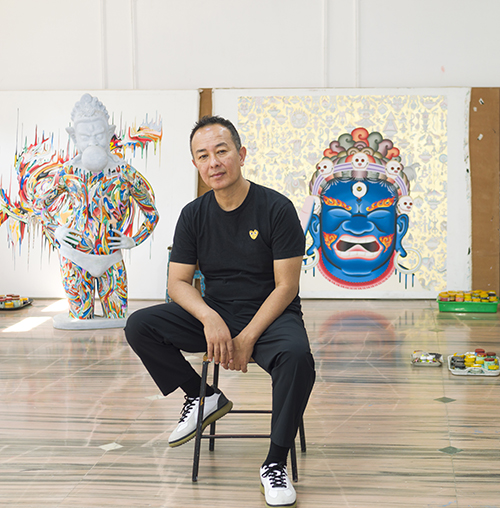
A contemporary vision rooted in an ancient tradition
Born in Kathmandu, Nepal, in 1968 to a Tibetan father and Nepalese mother,
Tsherin Sherpa was raised in a culturally and spiritually rich home. His
father, Urgen Dorje, was among Nepal’s most respected traditional Buddhist
painters, and Sherpa was trained in the exacting iconography of Himalayan
thangka painting. Yet from an early age, Sherpa was also immersed in
Kathmandu’s international atmosphere, exposed not only to centuries-old
Buddhist culture but also to the growing influx of global seekers, pop
aesthetics, mass-produced sacred images, Indian cinema posters, and comic-book
heroes. These converging influences formed the foundation of an artistic
sensibility that would later blossom into a bold and original reimagining of
Himalayan visual culture for the 21st century.
Sherpa’s personal journey—from Nepal to Taiwan to California—profoundly shapes his work. After initially leaving the traditional art world to study computer science, he returned to painting while living as an immigrant in the United States. Grappling with dislocation, cultural fluidity, and the search for belonging, Sherpa began weaving pop-culture references, news media imagery, and the emotional realities of migration into the established visual language of Himalayan Buddhist art.
Works such as Blue Spirit exemplify this striking fusion. A wrathful Bodhisattva—traditionally a guardian and guide—appears wearing a crown of skulls symbolizing impermanence while surrounded by silhouettes inspired by radio reports of global conflict: soldiers confronting demonstrators, a photojournalist documenting a Buddha, an oil tower looming across the scene. The deity’s tightly shut eyes and peace-sign gesture encapsulate the tension between spiritual ideals and worldly turmoil. In Sherpa’s hands, these figures become mirrors for the immigrant experience—resilient, adaptive “spiritual warriors” navigating disruption with hope, resourcefulness, and inner strength. Their struggles and triumphs echo those of displaced communities worldwide.
PROGRAMS
In Conversation: Tsherin Sherpa
May 30, 2-3:30 p.m., Doris Duke Theatre
Included with general admission, registration required, tickets at honolulumuseum.org/events Artist Tsherin Sherpa, curator of Asian art Shawn Eichman,
and senior curator of modern and contemporary art Tyler Cann discuss the
exhibition, the artist’s early training, navigating new cultures, and the
impact events such as the devastating 2015 Nepal earthquake have had on his
art.
Gallery Talk
Divine Disruption: The Art
of Tsherin Sherpa
July 10, 7-8pm, Galleries 12, 13,
14
Included with general admission,
registration required, tickets at honolulumuseum.org/events
Explore the world of Nepalese
artist Tsherin Sherpa as Curator of Asian Art Shawn Eichman takes you on an
inspiring journey through the exhibition Divine Disruption: The Art
of Tsherin Sherpa. Inspired by Himalayan Buddhist traditions, pop culture, and
important contemporary issues, Sherpa’s work is rich in meaning and references.
Divine Disruption: Curating the
Art of Tsherin Sherpa
Aug. 21, 7-8:30 p.m., Doris Duke
Theatre
Included with general admission, registration required, tickets at honolulumuseum.org/events
John Henry Rice, the E. Rhodes and
Leona B. Carpenter curator of South Asian and Islamic art at the Virginia
Museum of Fine Arts, joins HoMA curator of Asia art Shawn Eichman to discuss
the exhibition Divine Disruption: The Art of Tsherin Sherpa. Rice is the
leading scholar on Tsherin Sherpa’s work and he will share insights on the
artist’s unorthodox practice that explores contemporary social issues of
migration and globalization through the lens of personal experience, natural
disaster, and the influence of his early training in traditional Himalayan
Buddhist painting. Rice, a noted specialist in medieval and early modern South
Indian art and architecture curated the acclaimed exhibition Tsherin Sherpa:
Spirits, the artist’s first solo museum exhibition, at the Virginia Museum
of Fine Arts in 2022.
About the artist
Tsherin Sherpa (b. 1968, Kathmandu) is internationally
celebrated for transforming the visual language of Himalayan art to address the
complexities of modern life. His work has been featured in global exhibitions
and major institutions, including the Venice Biennale, and is recognized for
its profound blend of tradition, innovation, and emotional resonance.
Exhibition organization and
funding
Divine Disruption: The Art of Tsherin Sherpa is organized by the
Honolulu Museum of Art and the Seattle Art Museum.
National support for this for this exhibition has been provided by the E. Rhodes and Leona B. Carpenter Foundation.
The Honolulu Museum of Art presentation of this exhibition is provided by Sharon Twigg-Smith, the Vilcek Foundation, and Ruedi Thoeni and David Franklin.
Images available on request.
About the Honolulu Museum of Art
The Honolulu Museum of Art is Hawai‘i’s premier art institution, inspiring and uplifting the community through transformative art experiences. Founded in 1927 to reflect Hawai‘i’s multicultural makeup, today HoMA’s extraordinary collection of more than 55,000 works of art from across the globe spans 5,000 years.
Through its collection, innovative exhibitions, and programs, the museum is able to tell stories relevant to Hawai‘i and the world at large. It serves as a gathering place of learning and discovery, where visitors can encounter new ideas, explore diverse perspectives, develop empathy, and contribute to their well-being through art. Home to an art school, Honolulu’s last art house theater, two cafes, and a shop—just 10 minutes from Waikīkī—HoMA is a vital part of Hawai‘i’s cultural landscape committed to access for all.
Hours: Wednesday, Thursday, Saturday, Sunday 10am–6pm; Friday 10am–9pm
Admission: Adults $25; residents $15; free for youth 18 and under; free for SNAP beneficiaries and college students enrolled at any Hawai‘i state university or college.



Honolulu Museum of Art
900 S Beretania St
Honolulu, HI 96814
Honolulu Museum of Art School
1111 Victoria St
Honolulu, HI 96814
Communications: 808-532-8712
You are receiving this email because of your interest in the Honolulu Museum of Art.