
FOR IMMEDIATE RELEASE
Oct. 16, 2026
Media contacts
Lesa Griffith
808-532-8712
lgriffith@honolulumuseum.org
Lance Rae
808-781-1743
lance@tlcpr.com
HONOLULU MUSEUM OF ART EXPLORES GLOBAL STORY OF MODERN JAPANESE PRINTS
HONOLULU MUSEUM OF ART EXPLORES GLOBAL STORY OF MODERN JAPANESE PRINTS
'Through Modern Eyes: Shin Hanga Prints from the Honolulu Museum of Art’ looks at artistic and cultural connections between Hawai‘i, Asia and the wider world ahead of the Museum’s centennial
WHAT: Through Modern Eyes: Shin Hanga Prints from the Honolulu Museum of Art
WHEN: Feb. 27-July 11, 2027
WHERE: Honolulu Museum of Art, 900 S Beretania St., 808-532-8700
HONOLULU, HAWAI‘I—Opening February 27, 2027, Through Modern Eyes: Shin Hanga Prints from the Honolulu Museum of Art examines how artists reimagined centuries-old woodblock print traditions while responding to the social, cultural, and technological changes transforming Japan in the early twentieth century. On view through July 11, 2027, the exhibition brings together 82 prints from the Honolulu Museum of Art’s collection, offering a fresh perspective on one of the museum’s significant strengths.
Since the Honolulu Museum of Art opened in 1927, modern Japanese woodblock prints—known as shin hanga, or “new prints”—have been among the defining parts of its collection. Many of the works were included in founder Anna Rice Cooke’s original gift in 1927.
“The Honolulu Museum of Art is a place where visitors can discover different histories and narratives about Hawai‘i and the world,” said HoMA director and CEO David Odo. “Through Modern Eyes exemplifies this type of rich dialogue—using modern prints that are integral to the Museum’s 100-year history to tell timeless stories that can open doors for people to see ideas and perspectives that connect us all.”
Organized around three geographic themes—Japan, other parts of Asia, and places beyond Asia, including Hawai‘i and the continental United States—Through Modern Eyes looks at how travel, tourism, cultural exchange and shifting gender roles shaped artistic expression and perceptions of place. It also highlights Hawai‘i’s unique role as a center of artistic and cultural exchange in the Pacific, connecting cultures, ideas, and artistic traditions. It invites visitors to experience the enduring artistry of shin hanga and the lasting dialogue between Japan, Hawai‘i and the wider world.
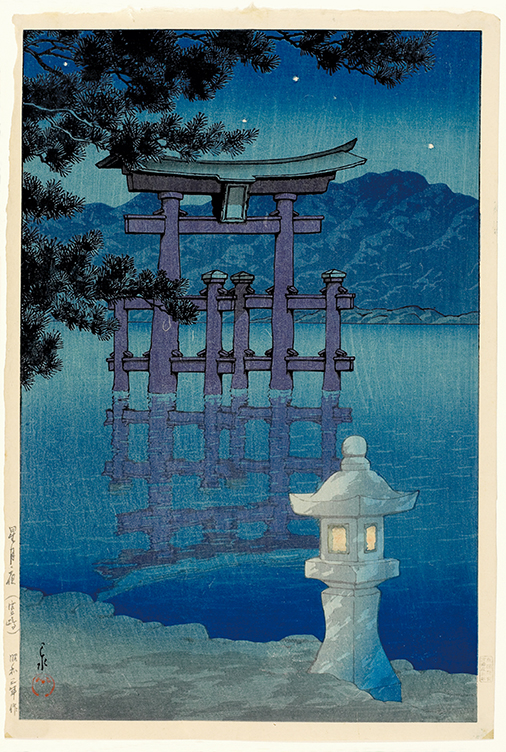
'Starlit Night, Miyajima,' 1928 by Kawase Hasui
The origins of shin hanga
After the US strongarmed Japan to
end its 200 years of isolationist policy and open its ports to trade and
foreigners in 1854, the country was inundated with Western painting,
photography, and printmaking. As these arts gained popularity, traditional
Japanese printmaking—ukiyo-e—was increasingly commercialized as
mass-produced illustrations, reportage, and advertisements.
Seeking to revive the refined craftsmanship and artistic prestige of Edo-period (1615-1868) printmaking, publisher Watanabe Shōzaburō (1885–1962) launched the shin hanga movement in 1915, collaborating with the Austrian artist Fritz Capelari (1884–1950) on some of its earliest works. Shin hanga preserved the traditional studio system, in which publishers, designers, carvers, and printers worked collaboratively, but incorporated Western techniques such as linear perspective, atmospheric effects, and chiaroscuro shading. Watanabe also sought to elevate woodblock prints to the status of fine art by emphasizing labor-intensive production methods that showcased the extraordinary skill of every participant in the printmaking process.
International artists also played an important role in shin hanga from its early years. British artist Charles W. Bartlett (1860–1940) and Scottish artist Elizabeth Keith (1887–1956) worked closely with Watanabe, creating prints of places rarely represented within earlier Japanese woodblock traditions, such as India, China, and the Philippines. French artist Paul Jacoulet (1896–1960), who grew up in Tokyo, depicted figures from Japan and Micronesia. Their work introduced audiences to places beyond Japan.
A collection with a global
perspective
Anna Rice Cooke’s 1927 founding
gift included many prints published by Watanabe, and the museum’s holdings have
grown to more than a thousand works. Drawing from this collection, Through
Modern Eyes explores how shin hanga embodies the tensions between
modernization and nostalgia as well as tourism and empire in the decades before
the Second World War. It brings together prints by Japanese and Western
artists.
The shin hanga prints in HoMA’s collection were produced over a span of fifty years and represent each of the movement’s major pictorial themes, including fūkei-ga (pictures of landscapes), bijin-ga (pictures of beautiful women), fūzoku-ga (pictures of genre scenes), yakusha-e (pictures of actors), and kachō-ga (pictures of birds and flowers).
This exhibition focuses on the first three of these genres—scenes of nature, individuals, and the community—to shed light on some of the social and political issues that influenced Japan, greater Asia, Hawaiʻi, and the United States during the interwar period of the 1920s and ’30s. These include the connections between tourism and colonialism, the opposing forces of nostalgia and modernity, and the growing awareness of women’s rights in Japan.
Also included in the show are drawings, watercolors, textiles, and accessories to put the prints into artistic and social contexts.
Visitors will encounter evocative views of Japan by Kawase Hasui (1883-1957), whose images of snow-covered temples, rain-soaked streets, and luminous night scenes helped to define international perceptions of the country. Works such as Snow at Zōjōji Temple, Rain in Maekawa, Sōshū, and Spring Snow, Kiyomizu Temple, Kyoto present Japan through atmosphere and seasonality, often emphasizing tranquility and timelessness during a time of rapid industrial change.
Other artists explored new ways of depicting the human figure. Hashiguchi Goyō's (1881–1921) Woman Combing Hair captures the female figure with refined linework, while Itō Shinsui’s (1898-1972) Contemplating the Coming Spring expands the expressive possibilities of prints through innovative carving and printing techniques.
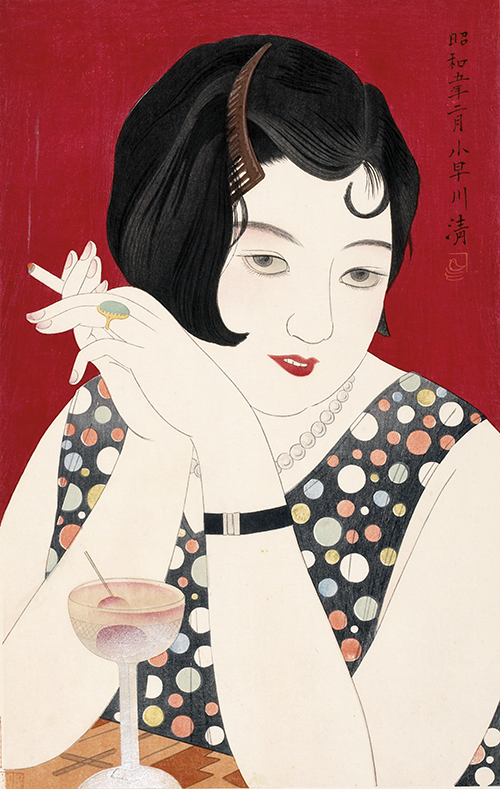
'Tipsy' by Kobayakawa Kiyoshi
Still other artists pushed bijin-ga in increasingly modern directions. In works such as Tipsy by Kobayakawa Kiyoshi (1899–1948), the figure of the “modern girl” (moga) in 1920s Japan appears in Western dress, with bobbed hair, cocktails, and cigarettes, embodying the cosmopolitan urban culture of interwar Japan and shifting gender norms.
Beyond Japan: Travel and tourism
Works by western artists are a strength of HoMA’s shin
hanga collection. Bartlett’s luminous scenes of India and Sri Lanka and
Keith’s images of Korea, China, and the Philippines illustrate how they
expanded the movement’s geographic scope while introducing new subjects. Keith’s
depictions of Korea during the period of Japanese colonial rule often frame
local architecture, dress and daily life through scenes of beauty and quiet
timelessness that obscure the realities of political occupation and
modernization.
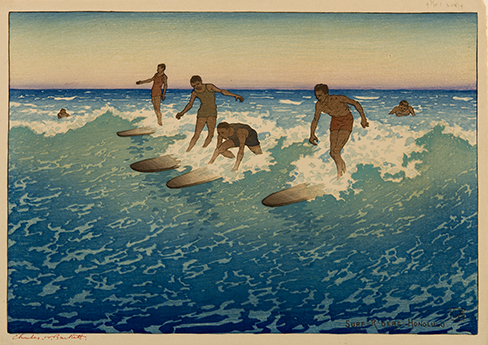
'Surf-Riders. Honolulu' by Charles Bartlett
Prints illustrating Hawaiʻi and other tourist destinations beyond Asia, such as Bartlett’s inviting Surf-Riders. Honolulu, promote exotic paradises, ignoring the unsettling colonialism the islands faced.
Opening in the lead-up to HoMA’s centennial in April 2027, the exhibition celebrates a collection that has been central to the museum’s identity for nearly a century while inviting new audiences to discover its enduring relevance. The exhibition creates opportunities for visitors of all ages to engage with Japanese art, deepen their understanding of cross-cultural exchange, and explore ways art reflects an interconnected world.
Rooted in the Honolulu Museum of Art’s collection and shaped by Hawaiʻi's position within the Pacific, this exhibition proposes a view of shin hanga that is both local and global. Hawaiʻi emerges as an active hub for the movement’s international networks of artists, publishers, collectors, and audiences. The exhibition recognizes shin hanga as a movement deeply connected to modern Japan, while also acknowledging the extent to which it was formed through transnational exchange and circulated across imperial, commercial, and cultural boundaries. By bringing together Japanese and foreign artists working within the medium, Through Modern Eyes highlights shin hanga as a collaborative and internationally oriented form of modern printmaking whose histories continue to resonate across the Pacific today.
Accompanying catalogue
The exhibition is complemented by
an illustrated catalogue with essays by the three curators. Designed for
general readers and scholars, the publication presents shin hanga not
only as works of extraordinary beauty but also as reflections of a changing
world.
Artists in the exhibition
Charles W. Bartlett, Itō Shinsui, Paul Jacoulet,
Hashiguchi Goyō, Kasamatsu Shirō, Kawase Hasui, Elizabeth
Keith, Kobayakawa Kiyoshi, Shirley Russell, Torii
Kotondo, Tsuchiya Kōitsu, Watanabe
Ikuharu, Yamakawa Shūhō, Yamamura
Kōka, Yokouchi Kiyoharu, Yoshida Hiroshi
About the curators
Stephen Salel is curator of Japanese art at the Honolulu Museum of Art. He received his MA in Art History from the University of Washington, where he specialized in early modern Japanese painting. His exhibitions include Lyrically Rebellious: The Prints of Onchi Kōshirō (2025–2026) and Enduring Impressions: Contemporary Woodblock Prints (2025), the latter of which he curated in collaboration with the Portland Japanese Garden / Global Center for Culture and Art in Portland, Oregon. Salel’s most recent publications are “From Expressions of Religious Devotion to Comic Art: The Evolution of Sugoroku Imagery” (Impressions: The Journal of the Japanese Art Society of America, Autumn 2024) and Before Modern Manga: The Attributes of Comics in Historical Works of Japanese Art (Routledge / Taylor & Francis, 2026).
Alejandra Rojas Silva is curator of European and American art at the Honolulu Museum of Art. Her curatorial work spans ancient to contemporary art, with exhibitions organized in the United States, Colombia, and Aotearoa New Zealand. At HoMA, she co-curated Home of the Tigers: McKinley High and Modern Art (2024–2025) and Satoru Abe: Reaching for the Sun (2024–2025); she also curated the museum’s presentation of Mary Cassatt at Work (2025), which examined Cassatt’s engagement with Japanese art and printmaking through works from HoMA’s collection. Rojas Silva holds an MSt in Art History from the University of Oxford and an MA and PhD in the History of Art and Architecture from Harvard University. Her scholarship examines representations of the natural world in colonial Latin America and their relationships to scientific knowledge, imperial power, and local identity. Her publications include “Flowers of the Colony, Seeds of Independence: The Illustrations of the Royal Botanical Expedition to Nueva Granada” (Selva: A Journal of the History of Art, no. 3, Fall 2021).
Kiyoe Minami is assistant curator of Japanese art at the Honolulu Museum of Art. Her recent research focuses on Edo-period popular culture and fashion as reflected in woodblock-printed books. At HoMA, she has curated exhibitions including Miyabi: Renaissance of Court Culture (2024) and Quiet Luxury: Subversive Fashion in the Edo Period (2026). Minami’s publications include “The Iconography of the Satsuma Vases in the Marignoli di Montecorona Foundation,” in The Kawānanakoa Satsuma Vases: Linking Japan and Hawai‘i, Marignoli di Montecorona Notebooks 3 (ARTEMIDE, January 2023), and “Exploring Heian Cultural Revival in Edo through the Jūban Mushi-awase Emaki at the Honolulu Museum of Art,” in Japanese Studies Spotlight (North American Coordinating Council on Japanese Library Resources, June 2024).
Images available on request.
Honolulu Museum of Art Centennial
On April 8, 2027, the Honolulu Museum of Art will kick off 18 months of events and programming to celebrate its centennial. Highlights include the unveiling of the relocated and reinstalled Arts of Hawai‘i Gallery, free admission throughout April, and the opening of a Creativity Hub—a community space of learning and discovery in the Honolulu Museum of Art School.
About the Honolulu Museum of Art
The Honolulu Museum of Art is Hawai‘i’s premier art institution, inspiring and uplifting the community through transformative art experiences. Founded in 1927 to reflect Hawai‘i’s multicultural makeup, today HoMA’s extraordinary collection of more than 55,000 works of art from across the globe spans 5,000 years.
Through its collection, innovative exhibitions, and programs, the museum is able to tell stories relevant to Hawai‘i and the world at large. It serves as a gathering place of learning and discovery, where visitors can encounter new ideas, explore diverse perspectives, develop empathy, and contribute to their well-being through art. Home to an art school, Honolulu’s last art house theater, two cafes, and a shop—just 10 minutes from Waikīkī—HoMA is a vital part of Hawai‘i’s cultural landscape committed to access for all.
Hours: Wednesday, Thursday, Saturday, Sunday 10am–6pm; Friday 10am–9pm
Admission: Adults $25; residents $15; free for youth 18 and under; free for SNAP beneficiaries and college students enrolled at any Hawai‘i state university or college.



Honolulu Museum of Art
900 S Beretania St
Honolulu, HI 96814
Honolulu Museum of Art School
1111 Victoria St
Honolulu, HI 96814
Communications: 808-532-8712
You are receiving this email because of your interest in the Honolulu Museum of Art.